Solver
Did this netlist, model, analysis, and solver configuration meet its stopping criteria?
CIRCUIT / SPICE / EVIDENCE LITERACY
Convergence means the numerical criteria were met for this netlist, model, analysis, and solver configuration. It does not establish numerical refinement, model validity, metric suitability, or signoff.
FIVE INDEPENDENT STATES
A simulator can finish while a timestep is too coarse. A refined waveform can use the wrong model. A validated model can still be measured with an incompatible metric. Signoff is a separate governed decision, never an automatic solver output.
Did this netlist, model, analysis, and solver configuration meet its stopping criteria?
Does a tighter timestep, tolerance, or saved-signal grid keep the scoped result inside declared limits?
Has the model been validated for the physical structure and operating range being claimed?
Are the required signals, thresholds, directions, interpolation, units, and limits compatible?
Has an independent governed review accepted the result for a precisely stated use?
READ IN ORDER
PASS, FAIL, and NOT_RUN are evidence states, not confidence colors. NOT_RUN remains visible when a downstream question was never tested.
Did this netlist, model, analysis, and solver configuration meet its stopping criteria?
Does a tighter timestep, tolerance, or saved-signal grid keep the scoped result inside declared limits?
Has the model been validated for the physical structure and operating range being claimed?
Are the required signals, thresholds, directions, interpolation, units, and limits compatible?
Has an independent governed review accepted the result for a precisely stated use?
THE V129 COUNTEREXAMPLE
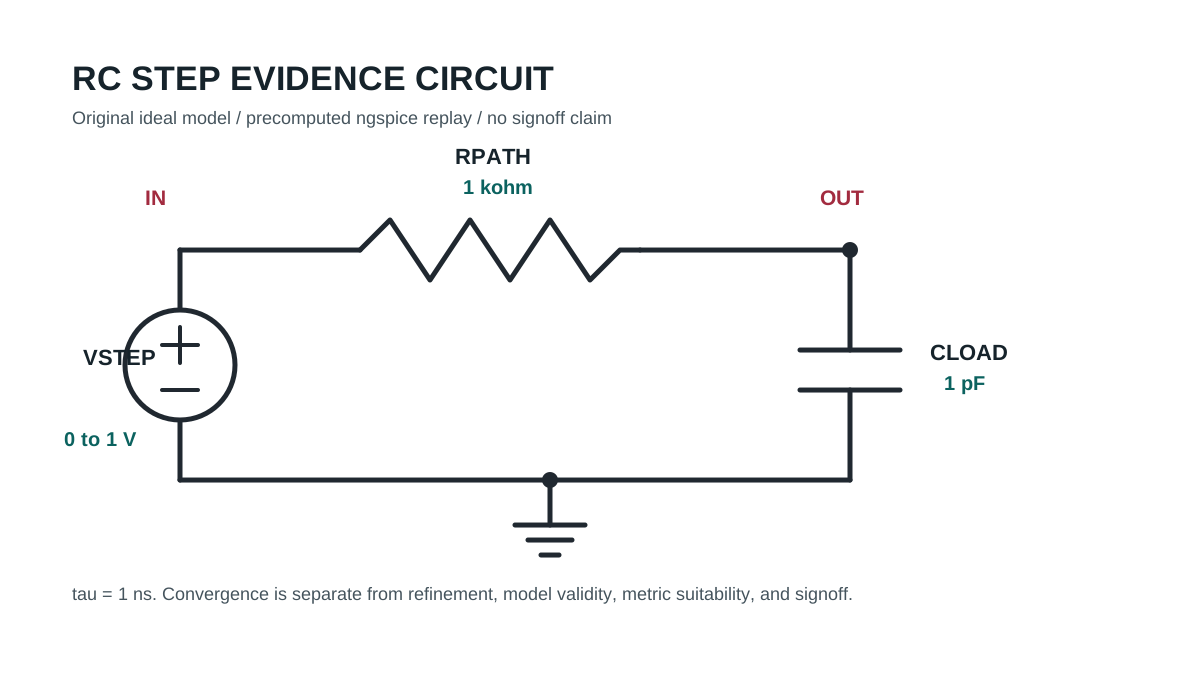
The 5 ps reference and 500 ps case both return solver PASS. The coarse case drifts only -0.002558% in mean output, yet its 50% delay moves enough to fail the 0.05% numerical limit and cross the locked 693.4 ps educational decision boundary.
METRIC CONTRACT
V129 locks the start and stop signals, 50% rising thresholds, linear interpolation, picosecond unit, and educational limit. Removing v(in), keeping sparse samples, or switching to first-sample crossing creates a different evidence packet.
v(in) starts; v(out) stops. Missing either signal blocks the metric.
Both crossings use 0.5 V on the rising direction.
Linear bracketing is not first-saved-sample selection.
A 250 ps saved interval can under-resolve a converged waveform.
693.4 ps is an educational check, never a production requirement.
SOURCE SPINE
These are link-only anchors. The RC netlists, SVG, replay dataset, decision limit, summaries, and report structure are original SemiAgora teaching artifacts.
No proprietary model, extracted interconnect, package, probe, measured calibration, process condition, production limit, qualification, foundry claim, or signoff follows from this original ideal RC example. All thresholds are locked educational evidence checks, not production limits.